 Email:admin@only-filter.com
The operational longevity of a gas turbine depends almost entirely on the quality of the air it breathes. Even microscopic particulate matter can cause catastrophic erosion of compressor blades and contaminate the combustion chamber, leading to unplanned downtime and significant efficiency losses.
Maintaining these high-precision machines requires a sophisticated filtration strategy that balances air permeability with absolute particle retention. This involves not just selecting a filter, but partnering with a specialized gas turbine air filter manufacturer capable of engineering media for extreme industrial environments.
This analysis explores the technical requirements of turbine filtration, the critical role of material science in preventing contamination, and the decision frameworks necessary for optimizing filtration lifecycles.


Contamination in gas turbines typically manifests as fouling or erosion. Fouling occurs when salt, oil, or dust accumulates on the compressor blades, altering their aerodynamic profile and reducing the pressure ratio. Erosion is more aggressive, where hard particles physically strip away the blade material, leading to permanent structural damage.
To combat this, the filtration system must act as an absolute barrier. The challenge lies in the "pressure drop" paradox: as filtration efficiency increases, the resistance to airflow also rises, which can paradoxically lower the turbine's overall power output.
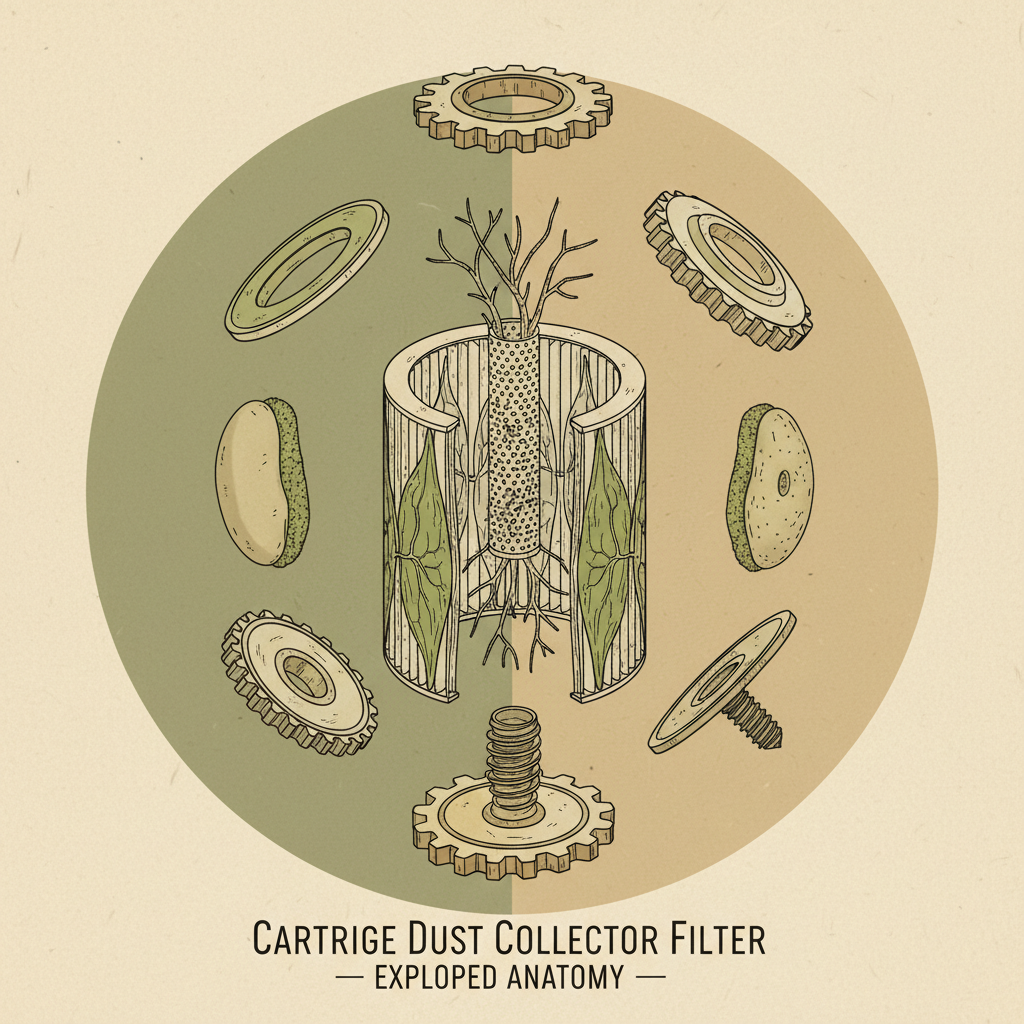
A professional-grade filter cartridge is more than just a piece of fabric; it is a precision-engineered assembly. The central skeleton provides the necessary structural integrity to prevent the media from collapsing under high vacuum pressures. Electro-galvanized skeletons are preferred to ensure the unit remains rust-free, even in humid environments.
The end caps and bottom covers serve as the critical interface between the filter and the housing. High-quality plastic covers or non-porous galvanized iron plates are used to prevent "bypass," where unfiltered air leaks around the edges of the media. A specialized sealing rubber ring is essential to maintain a hermetic seal during operation.
For specialized compressed air needs, chuck-type dust filter elements are employed. These cylindrical units focus on high dust filtration efficiency and ease of maintenance, featuring oil-resistant and anti-static properties to ensure safety in volatile industrial settings.
The choice of media determines the filter's efficiency and lifespan. Traditional materials are often replaced by imported long-fiber polyester, where fibers are interlaced and evenly distributed. This configuration offers superior wear resistance and the ability to withstand the intense pulse backwash used in automated cleaning systems.
Surface filtration leverages a tiny air-permeable tissue formed on the media surface to block particulates, preventing them from penetrating deep into the filter structure, which allows for repeated washing and longer service life.
Depending on the application, different materials are utilized: wood pulp fiber paper for basic particulate removal, spunbond polyester non-woven fabric for oil-proof and waterproof requirements, and metal wire mesh for liquid media or pre-filtration stages. These materials are often customized in dimensions, such as the common 325660mm or 350660mm standards.
When assessing a gas turbine air filter manufacturer, buyers must look beyond the nominal efficiency rating. The critical focus should be on the relationship between dust holding capacity, initial pressure drop, and the recovery rate after a cleaning cycle.
A high-performing filter maintains a stable differential pressure over a longer period, reducing the frequency of replacements and the energy required to push air through the system. The following index illustrates the relative importance of various technical factors in different operational environments.
The demands on air filtration vary wildly by site. In a typical industrial setting such as a pigment plant or wood processing facility, filters must handle high volumes of coarse dust, making the stiffness and washability of long-fiber polyester essential. Conversely, in chemical plants or mining operations, oil-resistance and anti-static coatings become the primary safety requirements to prevent combustion within the filtration housing.
Operational constraints also include environmental factors like humidity and temperature. In coastal regions, salt-laden air requires hydrophobic coatings to prevent the filter media from becoming "blinded" or clogged by moisture, which would otherwise lead to an abrupt spike in differential pressure and potential turbine trip.
Air purification has shifted from simple "barrier" filtration to "intelligent" filtration. Early systems relied on thick layers of cellulose that were replaced frequently. Modern systems, provided by ONLY TECHNOLOGY (HEBEI PROVINCE) CO., LTD, emphasize the use of advanced non-woven fabrics and precision-stamped galvanized components to extend the interval between maintenance cycles.
One significant trend is the movement toward customized specifications. Rather than relying on generic imported samples, manufacturers are now adjusting diameter and height (e.g., optimizing the 12.75" diameter standard) to maximize the surface area within existing housing footprints, thereby reducing the velocity of the air and improving particle capture.
Furthermore, the integration of Activated Carbon Filter Cartridges alongside dust removal elements allows for the simultaneous removal of gaseous contaminants and VOCs, protecting the turbine not just from physical particles, but from chemical corrosion.
Choosing the right filter requires a trade-off analysis. A filter with the highest possible efficiency may increase fuel consumption due to higher pressure drops. Conversely, a low-resistance filter may lead to more frequent turbine overhauls. The goal is to find the "economic equilibrium" where the cost of filtration is minimized relative to the cost of turbine maintenance.
Buyers should evaluate the manufacturer's ability to provide specific material certifications, such as the quality of the electro-galvanized skeleton or the grade of the imported polyester fibers. Ensuring that the seal is a specialized rubber ring rather than a generic foam gasket can prevent significant air leakage.
The following table provides a comparative framework for selecting the appropriate filter medium based on common industrial challenges.
| Environmental Challenge | Recommended Material | Key Performance Factor | Typical Application |
|---|---|---|---|
| High Coarse Dust | Long-fiber Polyester | Washability / Stiffness | Wood Processing |
| Oil Mist / Humidity | Coated Non-woven | Hydrophobic Properties | Chemical Industry |
| Fine Particulates | Wood Pulp Fiber | High Depth Filtration | General Manufacturing |
| Liquid Impurities | Metal Wire Mesh | Corrosion Resistance | Liquid Cooling Loops |
| Gaseous Pollutants | Activated Carbon | Adsorption Capacity | Environmental Control |
| Compressed Air Dust | Chuck-type Cartridge | Installation Efficiency | Pneumatic Systems |
Surface filtration uses a thin, permeable layer to block particles on the exterior of the media, which makes the filter easier to clean via pulse-jet systems. Depth filtration allows particles to penetrate the media and be trapped within the fiber matrix. For gas turbines, surface filtration is generally preferred for high-dust environments because it supports repeated washing and maintains a more consistent pressure drop over time.
The end cap is the primary seal point. If the end cap is poorly fitted or made of inferior materials, "air bypass" occurs, where unfiltered air enters the turbine, rendering the high-efficiency media useless. Using non-porous galvanized iron or high-grade plastic covers ensures a tight fit, while the addition of a specialized sealing rubber ring prevents leakage even under high-pressure fluctuations.
Yes, if the filter is made from high-stiffness materials like long-fiber polyester, it can be washed repeatedly. Many industrial systems use a pulse-backwash of compressed air to knock dust off the surface. However, the number of wash cycles depends on the nature of the dust; sticky or oil-laden particles may eventually "blind" the media, requiring full replacement regardless of the material stiffness.
Gas turbine air intakes are often exposed to varying humidity levels and outdoor pollutants. Standard steel skeletons are prone to oxidation (rust), which can weaken the structure and potentially release rust particles into the turbine air stream. Electro-galvanized skeletons provide a protective zinc layer that inhibits corrosion, ensuring the filter remains structurally sound over its entire service life.
Most industrial cartridges follow standardized dimensions, with common sizes being 12.75" in diameter and heights of 13.84" or 26" (roughly 325660mm and 350660mm). To ensure a perfect fit, it is best to provide a sample or exact measurements of the housing. A manufacturer can then customize the dimensions to prevent gaps that lead to unfiltered air leakage.
The most reliable indicator is the differential pressure gauge. When the pressure drop across the filter exceeds the manufacturer's recommended limit, it indicates the media is loaded. Other signs include a noticeable drop in turbine power output or an increase in fuel consumption, as the turbine must work harder to pull air through a clogged filter.
The cost of a high-quality filtration system is negligible compared to the cost of a single turbine blade failure. By focusing on the synergy between media material science, structural integrity, and precise sealing, operators can significantly extend the mean time between overhauls (MTBO) and optimize energy efficiency.
Whether utilizing standard dust removal cartridges or specialized carbon-based systems, the priority must remain on the total cost of ownership. Partnering with a technical manufacturer allows for the customization of specifications that align perfectly with the specific environmental challenges of your industrial site.