 Email:admin@only-filter.com
Selecting the right filtration components often determines the operational lifespan of industrial machinery. In environments where airborne particulate matter can cause catastrophic equipment failure or health hazards, the role of specialized filtration elements becomes critical.
Modern industrial air purification is no longer just about capturing dust; it is about balancing airflow resistance, durability against pulse-jet cleaning, and material compatibility with chemical contaminants. This shift has pushed manufacturers to innovate beyond simple paper filters toward advanced composite materials.
For procurement managers and plant engineers, understanding the technical nuances provided by dust filter cartridge manufacturers is essential for optimizing maintenance cycles and reducing downtime.


Dust filter cartridges operate primarily as surface filter elements. Unlike depth filtration, which traps particles throughout the thickness of the medium, surface filtration utilizes a tiny, air-permeable tissue formed on the exterior. This layer blocks particulate matter, creating a "dust cake" that actually assists in further filtration efficiency.
This mechanism is particularly effective for gaseous media filtration. By utilizing cylindrical elements, manufacturers maximize the surface area relative to the footprint, allowing for higher airflow rates while maintaining a strict barrier against fine particulates.
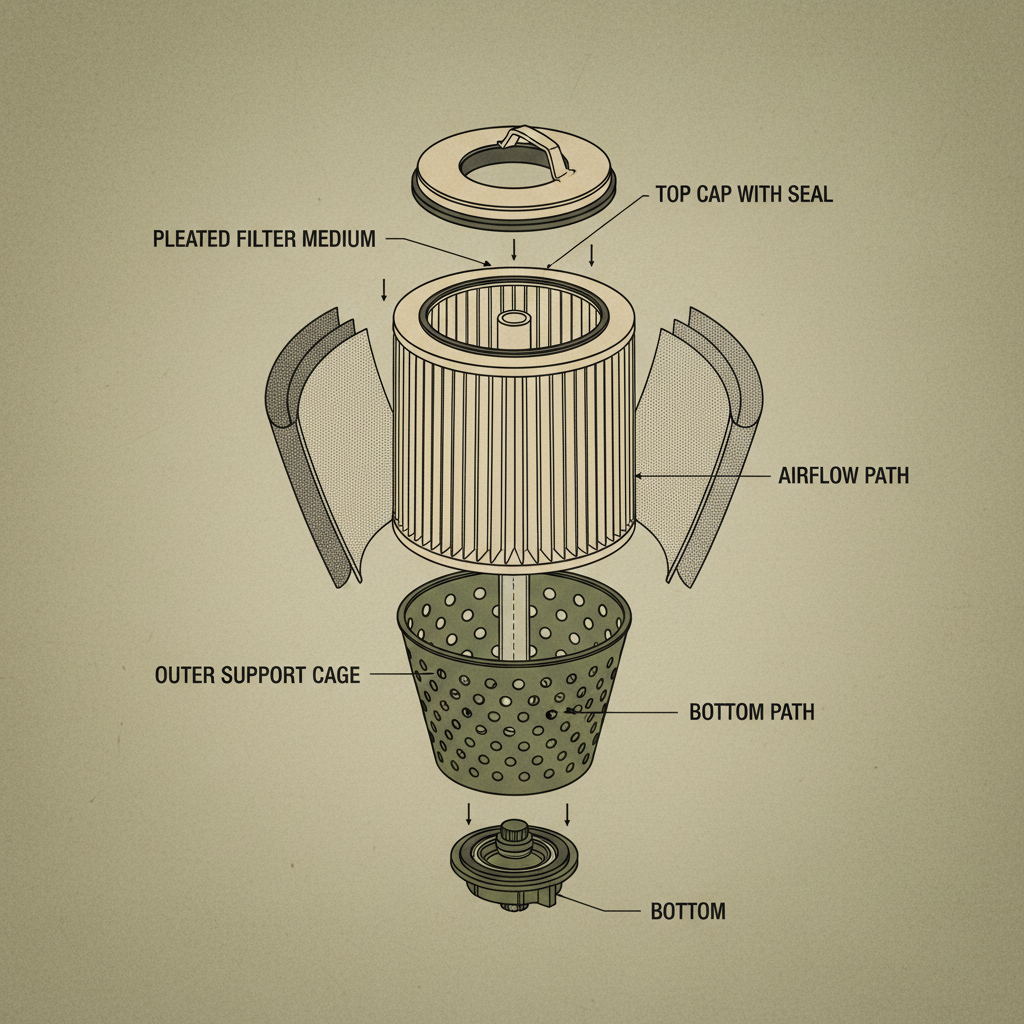
The structural integrity of a filter cartridge depends on the synergy between the filter media and the supporting skeleton. For high-stress environments, electro-galvanized central skeletons are preferred to prevent rust and structural collapse. The end caps, often made from high-grade plastics or stamped iron plates, ensure a leak-proof seal against the housing, preventing "bypass" where unfiltered air escapes around the element.
Material choice is dictated by the nature of the dust. Spunbond polyester fiber non-woven fabrics are widely used due to their versatility. These can be further enhanced with specialized coatings to provide oil-proof, waterproof, or anti-static properties, which are critical in volatile chemical or pigment industries.
In contrast, wood pulp fiber filter papers are utilized for specific air filtration needs where high initial efficiency is required, while metal wire meshes are reserved for liquid media filtration to remove larger impurities without clogging rapidly.
One of the primary causes of filter failure is the physical degradation of the media during cleaning cycles. Many industrial systems use pulse-backwash (compressed air blasts) to knock dust off the surface. Traditional materials often stretch or tear under this repeated mechanical stress.
The adoption of imported long-fiber polyester filter material, where fibers are interlaced and evenly distributed, provides the necessary stiffness to withstand high-pressure pulse backwash and allows for repeated washing without losing structural integrity.
This increased wear resistance directly translates to a longer replacement interval. When the media maintains its stiffness, the pore structure remains stable, preventing the "blinding" effect where particles become permanently embedded in the fabric, which would otherwise lead to an exponential increase in pressure drop.
Evaluating the performance of various filter media requires looking at a balance of filtration efficiency, pressure drop, and durability. While some materials offer superior initial capture rates, they may fail quickly in high-humidity or oil-rich environments.
By analyzing different media types—such as standard polyester, coated non-woven, and wood pulp—operators can determine the optimal balance for their specific air quality requirements.
The versatility of chuck-type dust filter elements allows them to be deployed across diverse industrial settings. In wood processing and the pigment industry, where fine, airborne powders are prevalent, high-stiffness polyester cartridges are used to ensure the air remains clean while resisting the abrasive nature of the dust.
For specialized operations like sandblasting or powder spraying, the focus shifts toward oil resistance and waterproofness. In these scenarios, ONLY TECHNOLOGY (HEBEI PROVINCE) CO., LTD provides tailored specifications, ensuring that the seal rings and filter materials are matched to the specific chemical profile of the process air.
Air purification standards are becoming increasingly stringent, moving toward a requirement for not only particle capture but also the reduction of energy consumption. Higher pressure drops in clogged filters force fans to work harder, increasing electrical costs.
The industry is seeing a move toward customized dimensions to optimize the air-to-cloth ratio. While standard sizes like 325660mm and 350660mm are common, customized cartridges allow plants to increase their filtration capacity without expanding the physical size of their dust collectors.
Furthermore, the integration of anti-static materials is becoming a safety requirement in environments where dust explosions are a risk, making the selection of non-conductive or specifically coated media a priority for safety officers.
Choosing between different filter cartridges requires a systematic assessment of the operational environment. A common mistake is selecting a filter based solely on the initial price, ignoring the total cost of ownership (TCO) which includes energy costs and replacement frequency.
Key factors include the moisture content of the air, the chemical composition of the dust, and the cleaning method employed by the system. For example, a filter suitable for dry wood dust will fail rapidly in a moist, oily chemical plant.
The following framework helps in evaluating the relative suitability of different filter configurations based on the most common industrial stressors.
| Condition | Wood Pulp Paper | Polyester Fiber | Coated Non-Woven | Metal Mesh |
|---|---|---|---|---|
| Dry Fine Dust | High | High | Medium | Low |
| Oil/Mist Air | Low | Medium | High | Medium |
| Pulse Cleaning | Low | High | High | Very High |
| Moisture/Water | Very Low | Medium | High | High |
| Chemical Vapor | Low | Medium | High | Low |
| Washability | None | High | High | Very High |
Surface filtration, used in most dust filter cartridges, captures particles on the outer layer of the media, forming a dust cake that enhances efficiency. Depth filtration traps particles throughout the thickness of the material. Surface filtration is generally easier to clean via pulse-jet systems, making it ideal for industrial dust removal where longevity and maintainability are key.
End caps ensure the air passes through the filter media rather than around it. Plastic covers are excellent for corrosion resistance and standard applications, while non-porous galvanized iron plates are preferred for high-pressure environments or specific industrial fittings. A poor seal at the end cap leads to "leakage," which significantly reduces the overall air purification efficiency of the system.
Coated polyester should be selected when the airflow contains moisture, oils, or chemical vapors. While standard polyester is great for dry dust, oil and water can saturate the fibers and cause the media to clog permanently (blinding). Specialized coatings provide hydrophobic and oleophobic properties, allowing these contaminants to be shed during the cleaning cycle.
Common industry standards often mirror imported specifications. Typical diameters are around 12.75 inches, with heights often being 13.84 or 26 inches. In metric terms, these are approximately 325660mm and 350660mm. However, many manufacturers can customize these dimensions to fit existing housings or optimize for specific airflow volumes.
The most reliable indicator is the differential pressure (Delta P) across the filter. If the pressure drop remains high even after several pulse-cleaning cycles, it indicates that the media has become blinded or physically degraded. At this point, the energy cost of pushing air through the filter outweighs the cost of replacement, and new cartridges should be installed to protect the downstream equipment.
Metal wire mesh is generally too porous for fine air purification; it is primarily used for liquid filtration or as a pre-filter to stop very large debris. For gaseous media and fine dust, non-woven fabrics or papers are required. However, metal mesh is invaluable in high-temperature environments where fabric media would melt or incinerate.
Optimizing industrial air quality depends on the precise alignment of filter media properties with the operational reality of the plant. From the stiffness of long-fiber polyester to the precision of galvanized skeletons, every engineering detail contributes to the system's efficiency and the facility's safety.
As industries move toward more sustainable and energy-efficient operations, the focus will continue to shift toward high-durability, low-resistance elements. Partnering with experienced manufacturers who can provide customized specifications ensures that air purification remains a reliable utility rather than a maintenance bottleneck.