In the demanding world of industrial power generation and air pollution control, the precision of air filtration can determine the operational lifespan of multi-million dollar assets. A hepa filter gas turbine solution represents the pinnacle of filtration technology, ensuring that only the cleanest air enters sensitive combustion chambers, thereby preventing erosion and fouling.
Globally, the transition toward high-efficiency energy production has placed an unprecedented emphasis on the quality of intake air. By implementing high-efficiency particulate air (HEPA) standards within gas turbine environments, operators can significantly reduce unplanned downtime and optimize fuel consumption across various industrial sectors.
Understanding the nuances of hepa filter gas turbine applications allows plant managers to move beyond generic filtration. By focusing on media area, pressure drop, and material compatibility, industries can achieve a seamless balance between absolute air purity and mechanical efficiency.
Global Relevance of HEPA Filtration in Gas Turbines
The global energy landscape is increasingly reliant on high-output gas turbines, which are susceptible to "compressor fouling"—a process where airborne contaminants settle on turbine blades. According to ISO standards for air intake filtration, even microscopic particles can lead to significant losses in thermal efficiency and power output. A hepa filter gas turbine configuration addresses this by removing 99.97% of particles as small as 0.3 microns, ensuring the engine operates at peak design specifications.
In regions with high industrial smog or desert environments, the challenge is magnified. The presence of abrasive silica or corrosive salts can cause rapid degradation of internal components. By deploying advanced HEPA-grade filtration, organizations can extend the intervals between expensive turbine overhauls, effectively reducing the total cost of ownership while adhering to stricter global emission and efficiency mandates.
Defining the HEPA Filter Gas Turbine Standard
In simple terms, a hepa filter gas turbine system is a specialized air purification stage designed to protect high-speed rotating machinery from the most minute airborne contaminants. Unlike standard dust filters, these utilize a dense web of randomly arranged fibers—typically fiberglass or high-grade synthetic polymers—that trap particles through interception, impaction, and diffusion.
This level of filtration is critical for modern industry because the tolerances in a gas turbine are incredibly tight. When air is compressed at supersonic speeds, any remaining particle becomes a high-velocity projectile. The HEPA standard ensures that these "micro-projectiles" are eliminated before they can enter the compressor, safeguarding the integrity of the turbine's aerodynamic profiles.
Beyond mechanical protection, this technology connects to humanitarian and environmental needs by maximizing the efficiency of power plants. Higher efficiency means lower fuel consumption per kilowatt-hour produced, directly reducing the carbon footprint of the facility and contributing to global sustainability goals.
Core Components of High-Efficiency Filtration
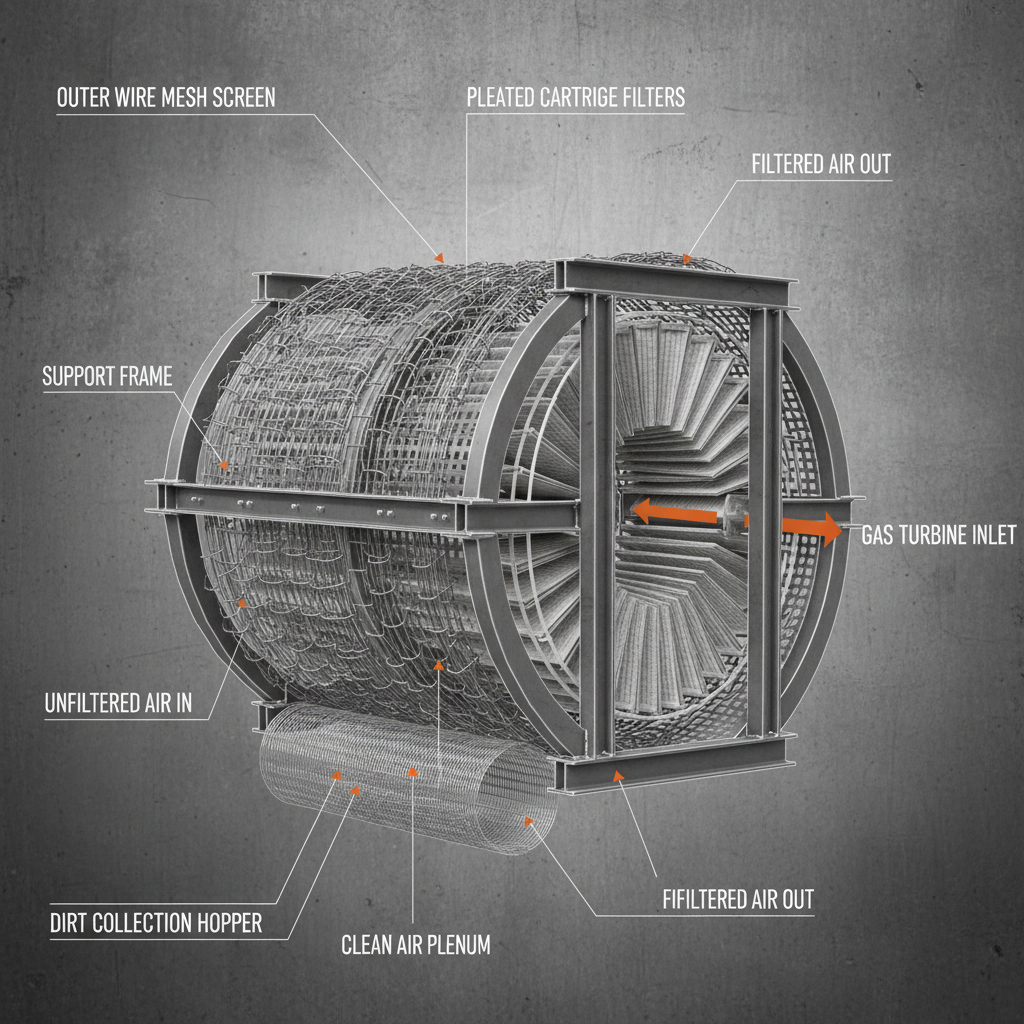
The structural integrity of a hepa filter gas turbine starts with the filter media. Whether utilizing pleated polyester, cellulose, or fiberglass, the media must provide a high surface area to capture dust and fumes without creating an excessive pressure drop that would starve the turbine of air.
Critical to the performance is the sealing technology. Utilizing polyurethane sealants and rubber gaskets ensures a leak-proof fit, preventing "bypass"—where contaminated air sneaks around the filter. For these cartridges, options like the PA6 flange or 4-lug design provide the mechanical stability needed to withstand the intense suction forces of a gas turbine.
Finally, the support structure, often a perforated inner core made of galvanized or stainless steel, prevents the media from collapsing under high differential pressure. This combination of high-grade media, airtight seals, and robust framing allows the hepa filter gas turbine to maintain a Class M or higher filtration efficiency over extended operational cycles.
Technical Performance Factors for Turbine Air
When evaluating the effectiveness of a hepa filter gas turbine, two metrics are paramount: the Media Area (m²) and the Maximum Operating Temperature. A larger media area, such as the 20m² available in our DJ-ADF-1200-07 model, allows for a higher dust-holding capacity and lower resistance to airflow, which directly translates to lower energy consumption for the intake fans.
Furthermore, temperature stability is vital. With a maximum temperature rating of 80℃ for standard polyurethane-sealed units, these filters are designed to handle the ambient heat of industrial power settings. For more extreme environments, custom-made fiberglass options can be engineered to withstand temperatures up to 200°C, ensuring the filter doesn't degrade under thermal stress.
Comparative Efficiency of HEPA Filter Gas Turbine Configurations
Real-World Industrial Applications
In practice, the hepa filter gas turbine is deployed across a spectrum of critical infrastructures. For instance, in pharmaceutical manufacturing plants, where air purity is non-negotiable, these filters are used in the auxiliary power units to ensure that no particulate contamination enters the clean-room environment via the power generation exhaust or intake.
Similarly, in remote industrial zones like offshore oil rigs or mining sites, the abrasive nature of the environment makes high-efficiency filtration a necessity rather than a luxury. By utilizing custom-made cartridges with anti-static coatings and reinforced frames, operators can prevent electrostatic discharge and ensure the turbines remain operational in the most hostile atmospheric conditions on earth.
Long-Term Value and Sustainability
The adoption of a hepa filter gas turbine strategy offers tangible economic benefits. By reducing the rate of compressor fouling, plants experience a measurable decrease in fuel consumption. Even a 1% increase in turbine efficiency due to cleaner air can result in millions of dollars in fuel savings over the lifetime of a large-scale power plant.
Beyond the balance sheet, there is a profound safety and reliability angle. Clean air intake prevents catastrophic blade failure caused by particulate erosion. This ensures the dignity and safety of the workforce by reducing the frequency of high-risk maintenance interventions and eliminating the possibility of sudden, unplanned equipment failure.
Sustainability is further enhanced through the use of washable media options. By extending the service life of the hepa filter gas turbine by up to 50%, companies can significantly reduce their industrial waste, aligning their operational goals with circular economy principles.
Innovations and Future Trends in Filtration
The future of the hepa filter gas turbine lies in the integration of "smart" materials. We are seeing a shift toward nano-fiber membranes that provide HEPA-level efficiency with a fraction of the thickness, drastically reducing the pressure drop and increasing the airflow efficiency for the turbine.
Digital transformation is also playing a role through the implementation of RFID tags and IoT sensors embedded in the filter frames. This allows for real-time monitoring of the pressure differential, moving maintenance from a scheduled "guess" to a precision-timed "need," thereby maximizing the utility of every filter cartridge.
As green energy transitions accelerate, these filters will evolve to handle hydrogen-blend fuels and other new combustion gases. The focus is shifting toward acid-resistant and flame-retardant materials, ensuring that the hepa filter gas turbine remains the first line of defense for the next generation of clean energy turbines.
Core Technical Specifications for HEPA Turbine Filtration
|
Filter Model Series
|
Media Area (m²)
|
Efficiency Grade
|
Max Temp (℃)
|
| DJ-ADF-300 (Standard) |
1.1 - 10.0 |
Class M / HEPA |
80 |
| DJ-ADF-600 (Mid-Range) |
2.1 - 11.0 |
Class M / HEPA |
80 |
| DJ-ADF-1000 (High-Cap) |
3.5 - 17.0 |
Class M / HEPA |
80 |
| DJ-ADF-1200 (Industrial) |
4.2 - 20.0 |
Class M / HEPA |
80 |
| Custom Glass-Fiber |
Up to 50.0 |
H13 / H14 HEPA |
200 |
| Anti-Static Special |
Variable |
Custom Grade |
120 |
FAQS
A HEPA filter gas turbine system is a high-efficiency air intake solution that removes 99.97% of particles 0.3 microns or larger. It is essential because gas turbines operate with extremely tight tolerances; any airborne dust or oil mist can cause "compressor fouling," which reduces power output, increases fuel consumption, and leads to premature wear of the turbine blades.
A larger media area (m²) increases the total surface available for trapping particles. This reduces the "face velocity" of the air passing through the filter, which lowers the pressure drop. A lower pressure drop means the turbine's intake system doesn't have to work as hard to pull in air, resulting in higher overall mechanical efficiency and lower energy costs.
While standard filters capture larger debris, they allow sub-micron particles to pass through. In a high-speed turbine, these particles can cause microscopic pitting and erosion. If your environment is highly contaminated or if you are running a high-precision turbine, upgrading to a HEPA-grade solution is critical to prevent long-term damage and maintain peak thermal efficiency.
Lifespan varies based on ambient air quality and dust load. However, by selecting cartridges with a larger media area and using washable options, the lifespan can be extended by up to 50%. Regular monitoring of the differential pressure (ΔP) is the best way to determine the exact replacement interval for your specific site.
Yes. Standard units with polyurethane sealants are typically rated up to 80℃. For applications involving higher ambient heat or specialized exhaust filtration, we offer custom-made fiberglass media and high-temp gaskets that can withstand environments up to 200℃, ensuring the filter does not warp or leak.
The most common indicator is an increase in the pressure drop across the filter bank. When the filter becomes loaded with dust, it resists airflow, causing a higher pressure differential. Other signs include a measurable drop in turbine power output or an increase in fuel consumption to maintain the same load.
Conclusion
Implementing a high-performance hepa filter gas turbine strategy is an investment in the longevity and efficiency of industrial power assets. By combining superior media area, precision sealing, and material science, these filters eliminate the risks of compressor fouling and blade erosion, ensuring that turbines operate at their maximum design capacity while reducing environmental impact.
As the industry moves toward smarter, more sustainable energy production, the role of precision filtration will only grow. We recommend that plant operators move away from generic replacements and toward custom-engineered solutions that align with their specific atmospheric challenges. For world-class filtration that elevates your system's performance, visit our website: www.onlyfiltercartridge.com.

 Email:admin@only-filter.com